Werewolf Secrecy Rule
I'm the Werewolf in my ClassThe Werewolf Secrecy Rule is the protective code requiring werewolves to conceal their identities and activities from humans. In Sebastian Wolfe’s story, it determines who may be told the truth, when disclosure becomes necessary, and how the pack responds when an ordinary school environment is overtaken by supernatural danger. The rule promises safety, yet its strictness repeatedly forces Sebastian to manage fear, loyalty, friendship, and responsibility at the same time.
Definition and Purpose
The rule is first presented as a family policy rather than a formal written law. After Sebastian’s first transformations, his father explains that other werewolf families exist but generally keep to themselves because separation is safer. This establishes secrecy as a collective survival strategy: concealment protects werewolf families from the human world and limits the risks created when supernatural identities become known.
The rule also structures the pack’s conduct. When Lily identifies Sebastian as one of her kind, she tells him to meet her at Crescent Hill Park at midnight, bring no one, and tell no one. Her instructions make secrecy immediate and practical. Sebastian is not merely learning that he is a werewolf; he is being taught that knowledge must be controlled, that meetings must occur away from public view, and that trust is granted selectively.
Secrecy and Sebastian’s Initiation
Sebastian’s first transformation makes the rule difficult to follow because his body reveals what he does not understand. He experiences nausea, shifting bones, crawling skin, and coarse dark hair emerging from his hands before the full moon appears and he releases a distinctly nonhuman howl. Afterward, his friends find him unconscious at the edge of the woods, and Nurse Chen reports that he had been acting strangely all morning. The school and medical setting interpret the episode through ordinary human concern, while Sebastian and his family understand that a hidden identity has already begun to leave visible traces.
The family’s explanation gives Sebastian a private vocabulary for those traces. His parents identify the episode as one of his first transformations and tell him that the changes will initially be unpredictable but can eventually be controlled. When he asks whether others like them exist, his father confirms that there are other werewolf families, while emphasizing that they keep apart for safety. Sebastian thinks of Lily’s invitation but withholds it from his parents, making secrecy not only a rule imposed by adults but also a choice he begins to exercise for himself.
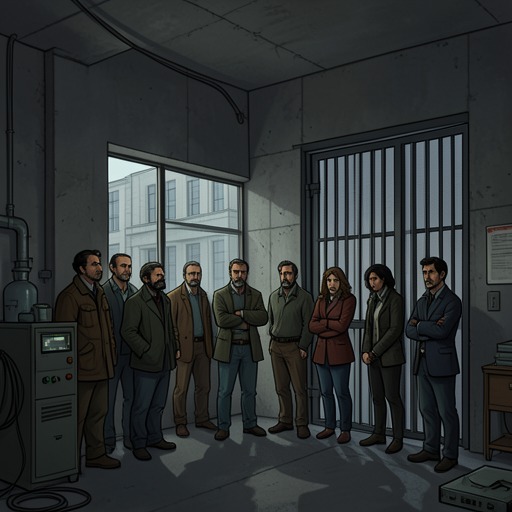
The pack then turns secrecy into belonging. At midnight in Crescent Hill Park, Lily welcomes Sebastian to the pack, where five other teenagers emerge into the moonlight with glowing eyes. Ethan introduces himself as the alpha of their small group. Sebastian recognizes some members from school and finds, among them, a sense of belonging he has never experienced before. The rule therefore has a double effect: it separates the pack from ordinary society, but it also creates a protected inner circle in which Sebastian’s hidden nature is acknowledged.
Operational Secrecy and the Protection of Humans
Once the pack encounters the rogues, secrecy becomes an emergency procedure. Ethan explains that the hostile werewolves are not merely passing through Crescent Hill; they want territory and are searching for something specific hidden there. The threat changes the meaning of concealment. The pack must not only hide its own existence but also prevent the conflict over the hidden artifact from spreading into human spaces.
That boundary is challenged at Crescent Hill High when a fire alarm sends students out of the cafeteria and Lily urgently pulls Sebastian toward a side exit. She tells him that the rogues are at the school and may have discovered his connection to the artifact. The ordinary evacuation system becomes cover for a supernatural intrusion, while the secrecy rule turns the students around Sebastian into people who must be moved, misled, or protected without being told why.
The rule is stated most explicitly when Sebastian, in wolf form, senses Mia near the clock tower. He communicates her presence to Ethan through projected thoughts. The pack reacts with concern because humans are not supposed to be involved and are considered too vulnerable to the danger. Ethan orders Lily to take Sebastian to find Mia and keep her safe while the rest of the pack holds off the rogues and searches for the artifact. Secrecy here authorizes a division of labor: human protection takes priority, but disclosure remains restricted and the larger fight continues elsewhere.
Disclosure, Betrayal, and Necessary Trust
Sebastian initially tries to preserve the boundary even after Mia finds him. When he shifts into human form in front of her, Lily retrieves emergency clothes from a hidden supply, allowing him to dress before he explains anything. Mia immediately asks whether he is really a werewolf, why he kept the truth from her, and who Lily is. Sebastian postpones the explanation, promising to explain everything later because they are still in danger and need to escape.
Mia refuses to accept secrecy as an adequate answer. She says that she has been worried about Sebastian, has noticed his strange behavior, disappearances, and secrets, and followed him because she cares about him and knew something was wrong. Her demand exposes the rule’s emotional cost. From the pack’s perspective, withholding the truth protects a human; from Mia’s perspective, concealment has already damaged trust and denied her the ability to decide how to respond to Sebastian’s danger.
The clock tower makes disclosure unavoidable. After the rogues breach the tower and the artifact becomes the immediate focus of the conflict, Sebastian fights to protect Mia. He ultimately undergoes a transformation that is neither simply human nor simply wolf, describing a new synthesis of both, and falls through the clock face with the rogue. When he wakes, Mia is beside him. She confirms that the rogues were defeated, the artifact is safe, and Sebastian is the only one who plunged from the building. His realization that she knows everything marks the rule’s decisive failure as a barrier between them, but not necessarily as the end of their relationship.
Consequences and Changing Meaning
The rule protects the pack during the crisis, but it also produces repeated concealment, abrupt commands, and dangerous misunderstandings. Sebastian must leave school without explanation, meet Lily in secret, keep the pack’s existence from his parents, and delay telling Mia the truth even while relying on her emotional concern. The secrecy that once seemed like a simple safeguard becomes a pressure system governing family authority, pack command, and personal loyalty.
At the same time, the story shows why the rule exists. Ethan treats Mia’s involvement as dangerous, and the pack’s response is to extract her from the battle rather than expose her to it. The rogues’ appearance at school demonstrates how quickly supernatural conflict can violate the boundary the rule is designed to maintain. Secrecy cannot prevent danger from entering the human world, but it shapes the pack’s attempt to contain the damage.
The rule’s final significance changes after the artifact bonds with Sebastian. Ethan explains that the artifact has reacted to him in a way the pack has never seen and that he has unlocked abilities beyond those expected of a werewolf. He is no longer merely shifting between human and wolf but has become something new. Mia responds by squeezing his hand and assuring him that he is not alone. This response does not erase the need for caution, but it suggests that survival may depend on chosen trust as much as concealment. The Werewolf Secrecy Rule remains a defense against exposure, yet Sebastian’s transformation and Mia’s knowledge reveal its limit: an identity cannot be kept safe indefinitely by keeping every person outside it.